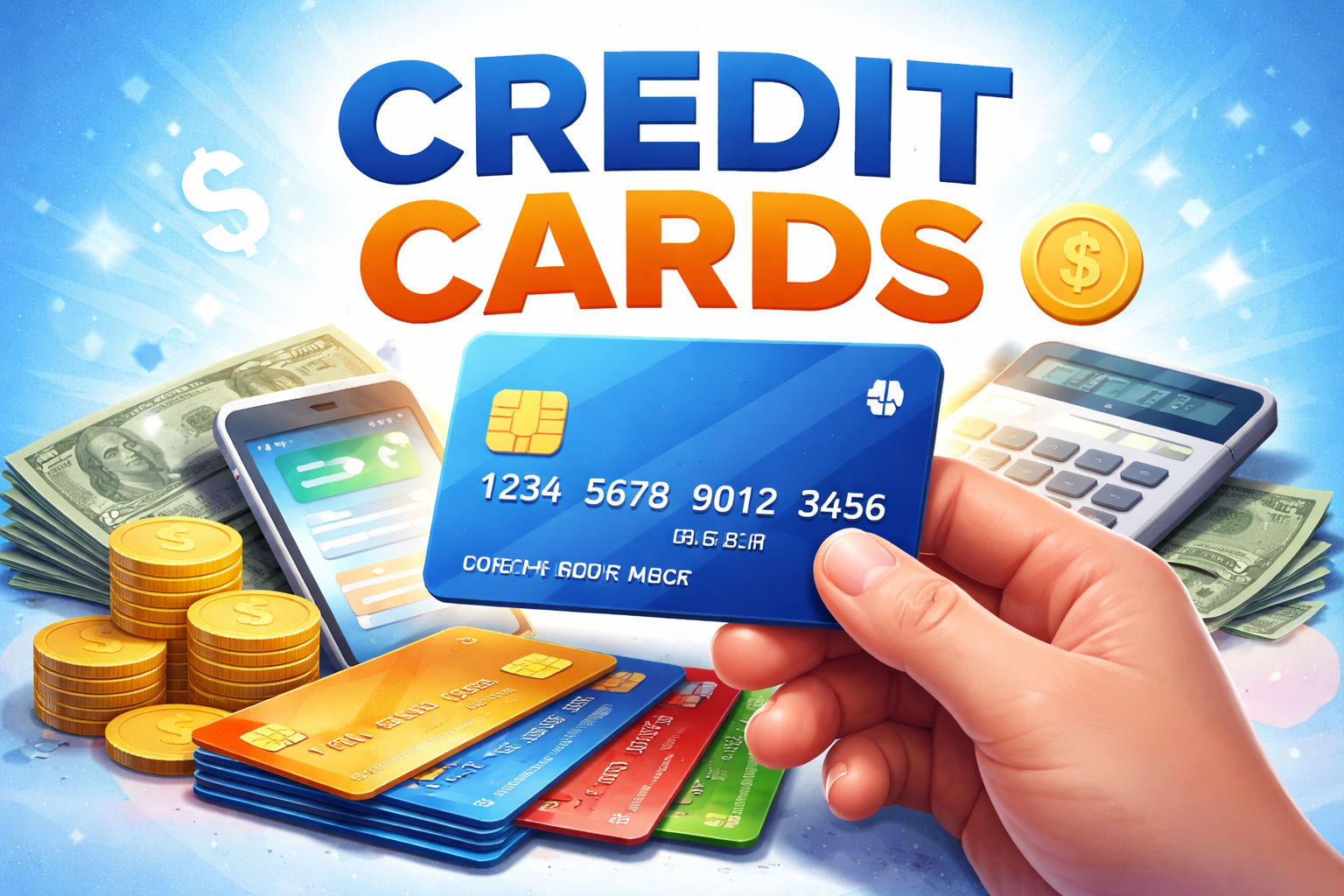
Credit cards are arguably the most polarizing financial product in existence. To some, they are viewed as a predatory debt trap designed to keep consumers on a treadmill of endless payments. To others, they are a sophisticated financial tool used to earn free first-class flights, generate hundreds of dollars in cash back, and build a fortress-like credit score.
The truth? A credit card is simply a power tool. Used correctly, it can help build your financial house. Used recklessly, it can cause catastrophic damage. Unlike a debit card, which directly drains your own checking account, a credit card is essentially a short-term, micro-loan from a bank.
This guide is designed to demystify the entire credit card ecosystem. We will break down the fundamental mechanics of how these cards operate, expose the mathematical reality of interest rates and minimum payments, explain the deep connection between your card and your credit score, and explore the increasingly complex 2026 landscape of premium rewards and AI integration.
Part 1: The Core Mechanics (How Credit Cards Actually Work)
To master credit cards, you first have to understand the underlying mechanics of what happens when you swipe, tap, or insert your chip.
Revolving Credit vs. Installment Loans
When you get a mortgage or a car loan, you are taking out an installment loan. You borrow a fixed amount of money and pay it back in equal, fixed monthly installments over a set period.
A credit card is a form of revolving credit. The bank gives you a specific “credit limit” (e.g., $5,000). You can borrow against that limit, pay it back, and borrow against it again, in a continuous revolving cycle. Your monthly payment is not fixed; it fluctuates based entirely on how much of that limit you actually spent that month.
The Magic of the Grace Period
This is the single most important concept to grasp if you want to use credit cards for free.
Almost all credit cards offer a grace period, which is typically the time between the end of your monthly billing cycle and your actual payment due date (usually 21 to 25 days).
- If you pay your “Statement Balance” in full before the due date, the bank will charge you $0 in interest. * You effectively get a 30-to-50-day free loan from the bank for every purchase you make.
- However, the moment you fail to pay the full statement balance and leave even $1 unpaid, you lose your grace period. The bank will immediately begin charging you daily compounding interest on your entire balance.
The Payment Networks
When you look at your card, you will usually see two logos. One is the Issuer (the bank that actually lends you the money, like Chase, Capital One, or Citi). The other is the Payment Network (Visa, Mastercard, American Express, or Discover).
The network is the technological bridge that connects the merchant’s cash register to your bank to verify you have the funds. The network charges the merchant a “swipe fee” (usually 1.5% to 3% of the transaction) every time you use the card. This fee is how banks afford to pay you cash back and travel rewards.
Part 2: The Anatomy of Costs (APR, Fees, and Minimum Payments)
Credit card companies are highly profitable businesses. While they make billions off merchant swipe fees, they make even more off consumer mistakes. Here is how they charge you:
1. The Annual Percentage Rate (APR)
The APR is the interest rate you are charged if you carry a balance from month to month. Credit card APRs are notoriously astronomical—often ranging from 20% to 30% or higher.
Because credit cards are unsecured debt (there is no physical asset like a house or a car for the bank to repossess if you stop paying), the bank charges a massive premium to offset their risk. Furthermore, credit card interest calculates on a daily periodic rate. This means your interest compounds daily; you are paying interest on your interest, causing debt to spiral out of control incredibly fast.
2. The Minimum Payment Trap
When you receive your monthly statement, you will see a “Minimum Payment Due” (often calculated as 1% to 2% of your total balance, plus interest). This is a psychological trap. If you owe $5,000 on a card with a 24% APR and you only make the minimum payment of $150, it will take you over four years to pay off the card, and you will pay roughly $3,000 in pure interest along the way. Paying only the minimum is a recipe for lifelong financial struggle.
3. The “Fee” Ecosystem
Beyond interest, cards are loaded with various fees:
- Annual Fees: Many premium rewards cards charge a yearly fee to own the card, ranging from $95 to nearly $700. We will discuss later when this math actually makes sense.
- Late Fees: If you miss your payment due date by even one day, you will be hit with a late fee. (While regulators heavily battle over capping these fees, missing a payment also triggers penalty APRs and damages your credit score).
- Foreign Transaction Fees (FTF): Many basic cards charge a 3% fee on any purchase made outside your home country. If you travel internationally, you must use a card with no FTFs.
- Cash Advance Fees: If you put your credit card into an ATM to withdraw physical cash, you will be hit with a massive upfront fee (often 5%), and the interest starts compounding the exact second the cash comes out (there is no grace period for cash advances). Never do this.
- Balance Transfer Fees: If you move debt from a high-interest card to a 0% introductory card, the new bank will usually charge a 3% to 5% fee on the total amount transferred.
Part 3: The Credit Score Connection
In the modern world, your credit score (usually your FICO score) is your financial reputation. It dictates your ability to rent an apartment, get a mortgage, secure cheap car insurance, and sometimes even get a job.
Credit cards are the fastest, most effective way to build that score, provided you understand the algorithm. Your FICO score is heavily weighted by two main factors related to your cards:
1. Payment History (35% of your score)
This is the most critical factor. Have you paid your bills on time? A single payment that is 30 days late can drop an excellent credit score by 50 to 100 points instantly. Setting up “Auto-Pay for the Statement Balance” is the ultimate safeguard against this.
2. Credit Utilization Ratio (30% of your score)
This measures how much of your available credit you are actually using. If you have a single credit card with a $10,000 limit, and your current balance is $3,000, your utilization is 30%.
- The Rule of Thumb: Never let your statement close with a utilization over 30%. It signals to lenders that you are desperate for cash and overextended.
- The Pro-Move: To achieve top-tier credit scores (800+), keep your utilization under 10%. (You can cheat the system by paying off your card before the statement billing cycle ends, ensuring a $0 balance is reported to the credit bureaus).
3. Length of Credit History (15% of your score)
The longer you have had credit, the more reliable you appear. This is why you should rarely close your oldest credit card. Even if you don’t use it anymore, keeping your oldest, no-annual-fee card open anchors your average age of accounts and keeps your score high.
Part 4: Exploring the Types of Credit Cards
The market is flooded with thousands of different cards. Choosing the right one depends entirely on your current financial standing and lifestyle.
1. Secured Credit Cards (The Rebuilders)
If you have terrible credit or zero credit history, banks will not trust you with an unsecured card. A secured card requires you to put down a cash deposit (e.g., $300), which becomes your credit limit. If you don’t pay your bill, the bank keeps your deposit. After 6 to 12 months of responsible use, the bank will refund your deposit and upgrade you to a standard card.
2. Cash-Back Cards (The Pragmatists)
These are straightforward and incredibly popular. Every time you swipe, a percentage of the purchase is deposited back into your account.
- Flat-Rate Cards: Offer a simple, universal rate on everything you buy (usually 1.5% or 2% cash back).
- Category/Tiered Cards: Offer high cash back (3% to 5%) on specific categories like groceries, dining, or gas, and 1% on everything else.
3. Travel Rewards Cards (The Optimizers)
Instead of cash, you earn points or miles. This is where the highest value lies, but also the most complexity.
- Co-Branded Cards: Tied directly to a specific airline or hotel (e.g., a Delta SkyMiles card or a Marriott Bonvoy card). Great if you are hyper-loyal to one brand.
- Transferable Points Cards: The gold standard (like Chase Sapphire, Amex Gold/Platinum, or Capital One Venture). You earn bank points that you can transfer 1:1 to dozens of different airline and hotel partners.
4. Balance Transfer Cards (The Debt Relievers)
If you are drowning in high-interest debt, these cards offer a 0% APR introductory period (usually 12 to 21 months). You transfer your existing debt to this card, allowing you to attack the principal balance without compounding interest holding you back.
Part 5: Modern Trends (The 2026 Credit Card Landscape)
The credit card industry is evolving rapidly. What worked in 2020 no longer works today. If you are entering the rewards game in 2026, here is what you need to know:
1. The “Coupon Book” Premium Card Era
Annual fees are skyrocketing. Cards that used to cost $450 are now pushing $695 or more (like the Amex Platinum, the newly launched Bilt Palladium, and the Robinhood Platinum). To justify these massive fees, banks are stuffing the cards with dozens of hyper-specific monthly statement credits (e.g., $10 a month for Uber, $20 a month for streaming, credits for Oura rings or lululemon). You have to treat these cards like coupon books, actively tracking your spending to ensure you actually recoup the annual fee.
2. The Rise of Agentic AI
In 2026, Visa and Mastercard have begun rolling out AI-driven commerce suites. We are entering an era where you can grant an AI “agent” permission to analyze your credit card portfolio and autonomously select which card to use at checkout to maximize your rewards, or automatically apply your statement credits before they expire.
3. The Devaluation of Points & Lounge Crackdowns
As more consumers have flocked to travel rewards, the airlines and hotels have fought back by making points worth less. Transfer ratios are changing (e.g., certain banks requiring more points to book the same flight as last year). Furthermore, airport lounges became so overcrowded that issuers like Capital One and Amex have implemented severe crackdowns in 2026, stripping lounge access away from authorized users and increasing spend requirements to bring guests.
Part 6: Golden Rules for Credit Card Success
If you take nothing else away from this guide, adhere strictly to these four rules:
- Treat it like a debit card. Never buy something on a credit card unless you already have the cash sitting in your checking account to pay for it that very second.
- Pay the statement balance in full, every single month. Do not pay the “minimum.” Do not pay “most of it.” Pay every single penny of the statement balance.
- Never pay interest to earn rewards. The math never works. If you carry a balance and pay 25% in interest, earning 2% cash back or a few airline miles is a massive mathematical loss.
- Set up Auto-Pay immediately. The moment you activate a new card, log into the app and set it to automatically pull the full statement balance from your checking account three days before the due date. Remove human error from the equation.